
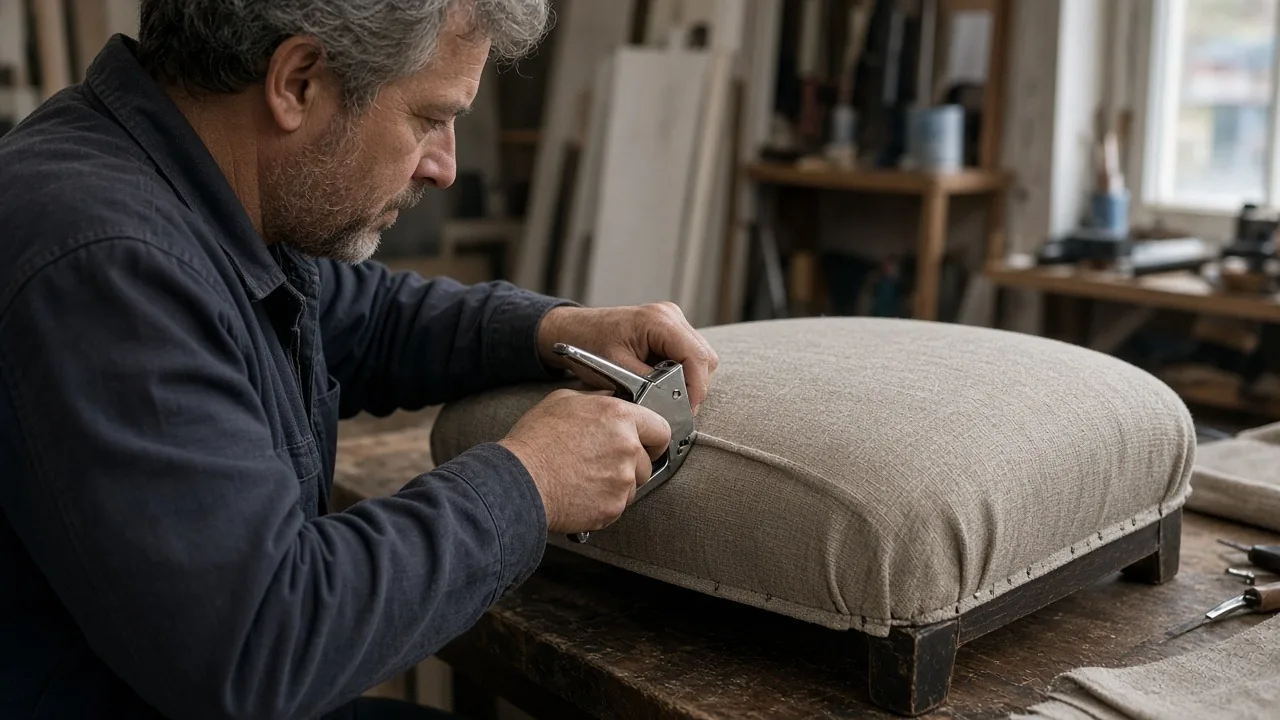
Yes — upholstery businesses can get funding, and most of it pays for fabric and foam ahead of a job, industrial sewing and cutting equipment, and the gap while a commercial client pays its invoice. Funders look at your deposits, time in business and what the money will buy. One 2-minute application matches you to the funders whose guidelines you meet.
Why is funding different for an upholstery business?
An upholstery shop is funded on job-by-job cash flow rather than shelf inventory. Most residential work is paid as a deposit at booking and a balance on pickup, while commercial work — restaurant booths, hotel headboards, medical and office seating, boat and vehicle interiors — is often invoiced after delivery. The money question is usually timing: materials are bought weeks before the final payment arrives.
It is also a business of very small firms. In the Census Bureau’s 2022 Statistics of U.S. Businesses, the reupholstery and furniture repair industry had 3,255 employer firms, and 2,546 of them — about 78% — had fewer than five employees. Those small shops averaged roughly $212,000 in annual receipts. Funders that understand that profile read a one- or two-person shop on its deposit pattern and job mix, not on the balance sheet of a factory.
What funding options fit upholstery shops best?
Match the product to what you are paying for. A walking-foot sewing machine that lasts a decade is a different need from the fabric for one restaurant contract.
- Business line of credit: for fabric, foam, webbing and springs bought ahead of jobs, drawn per job and repaid when the balance is paid, so you pay only for what you use.
- Equipment financing: for industrial walking-foot machines, pneumatic staplers and compressors, foam cutters, or a van for pickup and delivery, with the equipment as collateral.
- Invoice factoring: for commercial and contract work billed on 30- to 60-day terms, where the customer is a business that pays reliably but slowly.
- Merchant cash advance: a fast option repaid as a share of card sales; generally costlier, so compare it against a line before using it for routine materials.
How do you fund materials for a large commercial job?
Fund the materials for the job, and repay from that job’s payment. The common trap is taking a lump sum sized for a busy season and then paying for idle money between contracts. A revolving line drawn when the fabric is ordered and cleared when the invoice is paid follows the job’s own cash cycle, and it is easier to size because you know the materials bill in advance.
A simple illustration: a restaurant asks for 24 booths to be re-covered, and the fabric, foam and supplies come to $6,000, ordered before work starts. The job is invoiced on 30-day terms after installation, so the cash is out for roughly six to eight weeks. Drawing $6,000 against a line and repaying it when the restaurant pays costs interest only for those weeks. If several commercial invoices are open at once, factoring the receivables can free that cash without waiting. For residential work, take a deposit that at least covers materials, so customer jobs fund their own fabric. Our guide to funding inventory and materials purchases covers when a larger one-time stock-up makes sense.
How does an upholstery business qualify for funding?
Funders typically want recent business bank statements, a minimum time in business and, for equipment, a written quote. A shop with several months of steady deposits matches with more funders than a brand-new one, and commercial contracts or repeat trade accounts help show that work keeps coming. A new shop without much history will find fewer options, and equipment financing is usually the first one available because the machine secures it.
Run job deposits and final payments through one business account, keep material purchases on the same account, and be ready to explain a slow month or a single large job that skewed the numbers. The Broker Shop is a funding broker, not a lender: one application goes to the funders in our network whose guidelines fit an upholstery business, so they compete for the deal. That matters because one application is no guarantee — in the Federal Reserve Banks’ 2025 Small Business Credit Survey, 42% of employer-firm applicants received the full amount they sought. Checking your options won’t affect your credit score. For related trades, see funding for woodworking businesses and funding for furniture stores, and for the full product list, all small-business funding options.
Order the fabric before the deposit clears
Commercial jobs pay after delivery; the materials are due now. One 2-minute application is matched to the funders whose guidelines you meet. It's free, and checking your options won't affect your credit score.
See What I Qualify For →The bottom line: Upholstery businesses do best funding each job’s materials with a flexible line repaid from that job’s payment, financing equipment only when it adds work, and factoring slow commercial invoices when several are open at once — one 2-minute application matches you to the funders whose guidelines you meet.
Frequently asked questions
Sources: U.S. Census Bureau — 2022 Statistics of U.S. Businesses (SUSB) annual tables (NAICS 811420 Reupholstery and Furniture Repair: 3,255 employer firms, 2,546 with fewer than 5 employees, $539.8M receipts in that band); Federal Reserve Banks — 2026 Report on Employer Firms, Small Business Credit Survey (42% of applicants received the full amount sought)