
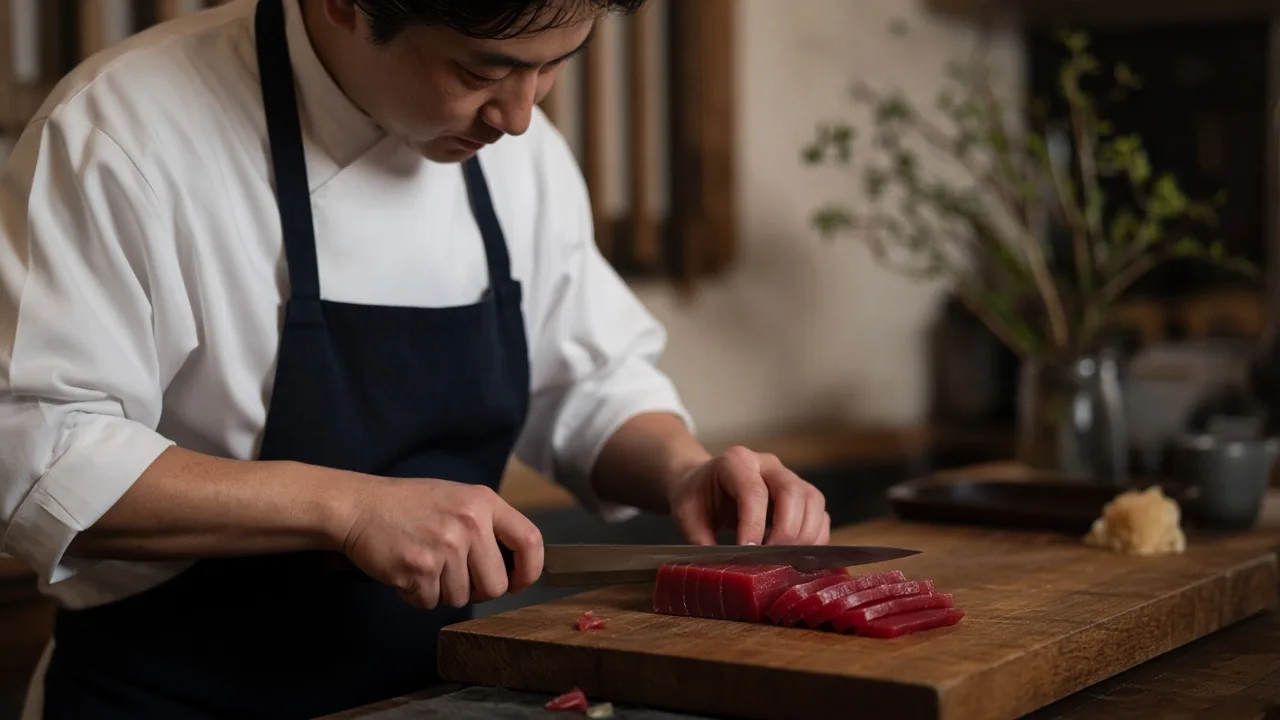
Yes — sushi restaurants can get funding, and most of it pays for two things: premium fish bought days before it is sold, and the refrigeration and build-out a raw-fish kitchen needs. Funders look at steady card deposits, time in business and what the money will buy. One 2-minute application matches you to the funders whose guidelines you meet.
Why is funding different for a sushi restaurant?
A sushi restaurant carries the most perishable, most expensive inventory in food service, and it pays for that inventory before the plate is sold. Fish for raw service has a shelf life measured in days, so the walk-in is restocked several times a week, and every order has to be paid on the supplier’s terms, not on the timing of your Friday rush.
Most of that fish comes from abroad. NOAA Fisheries estimates that 82% of the seafood Americans ate in 2024 came from foreign imports, and the U.S. imported 6.4 billion pounds of edible seafood that year. Import-dependent supply means prices move with exchange rates, freight and catch levels you cannot control, so a sushi bar needs working capital that absorbs a price jump without cutting the menu.
What funding options fit sushi restaurants best?
Match the product to the purchase. Fish bought this week and a refrigerated display case that lasts a decade are different needs, and pricing them the same way costs money.
- Business line of credit: for fish and rice orders drawn as needed and repaid as covers are paid, so you only pay for what you use.
- Restaurant equipment financing: for sushi display cases, ultra-low-temperature freezers, rice cookers and warmers, and walk-in coolers, with the equipment as collateral.
- Merchant cash advance: a fast option underwritten on card receipts and repaid as a share of sales; generally the costlier choice, so compare it against a line first.
- Term funding: for a build-out, a sushi bar counter, hood and plumbing work, or a second location, where a fixed payment over a set term fits a one-time project.
How do you fund fish inventory without wasting it?
Fund the fish you will sell before it turns, and repay on roughly the same cycle. Your sales history already tells you which cuts move — salmon, tuna and yellowtail usually carry the volume — so those deserve standing orders, while specialty fish for omakase or weekend specials is better bought against reservations than on speculation.
A line of credit suits this pattern because you draw before a delivery and pay it down as the weekend’s card deposits land. Borrowing a lump sum to stock up rarely works for raw fish: the product spoils faster than the payment schedule runs, and you end up paying interest on waste. Tight ordering protects the margin more than any rate does.
Should you finance refrigeration, a build-out or a second location?
Finance equipment when it protects food or adds covers you currently turn away. A failing walk-in or a display case that cannot hold temperature is a food-safety problem as much as a cost, and an ultra-low freezer lets you buy tuna in larger lots when the price is right. Those purchases usually fit equipment financing, with the asset securing the payment.
A second location or a full build-out is a bigger bet. Sushi depends on skilled chefs, and a new room that cannot be staffed with one will not earn its payment. Fund expansion once the first location runs without you behind the counter every night, and model the payment against a conservative cover count rather than your best month.
How does a sushi restaurant qualify for funding?
Funders typically want recent business bank statements, card processing statements, a minimum time in business and, for equipment, a written quote. A restaurant with several months of steady deposits matches with more funders than one with a short or uneven history, and a lower credit score narrows the options without automatically ruling a restaurant out.
Expect to be asked how the money will be used and how it will be repaid. In the Federal Reserve Banks’ 2026 Report on Employer Firms, 42% of small-business applicants received the full amount they sought, so a clear use of funds — a specific cooler, a specific build-out quote, a defined inventory line — helps the file. Our guide to restaurant business loans covers the terms and paperwork in more depth.
How does matching through a broker work?
The Broker Shop is a funding broker, not a lender. You complete one short application and we send it to the funders in our network of 50+ whose guidelines fit a sushi restaurant, so they compete for the deal. That matters because a single funder can only offer its own product, while several offers side by side let you compare total cost, payment frequency and term.
It is free to apply, and checking your options won’t affect your credit score. No approval, amount or rate is guaranteed — every offer depends on your restaurant’s numbers. For a wider look at who funds restaurants, see the best restaurant funding companies and the restaurant industry statistics.
Keep the fish case full
When a delivery is due before the weekend’s sales land, working capital decides what goes on the menu. One 2-minute application is matched to the funders whose guidelines you meet. It's free, and checking your options won't affect your credit score.
See What I Qualify For →The bottom line: Sushi restaurants do best funding perishable fish with a flexible line repaid as covers are paid, and financing refrigeration or a build-out only when it protects food or adds covers — one 2-minute application matches you to the funders whose guidelines fit, so you can compare real offers.
Frequently asked questions
Sources: NOAA Fisheries — Fisheries of the United States (2024 data) (82% of seafood eaten in the U.S. imported; 6.4 billion pounds of edible seafood imported); Federal Reserve Banks — 2026 Report on Employer Firms, Small Business Credit Survey (42% of applicants received the full amount sought)