
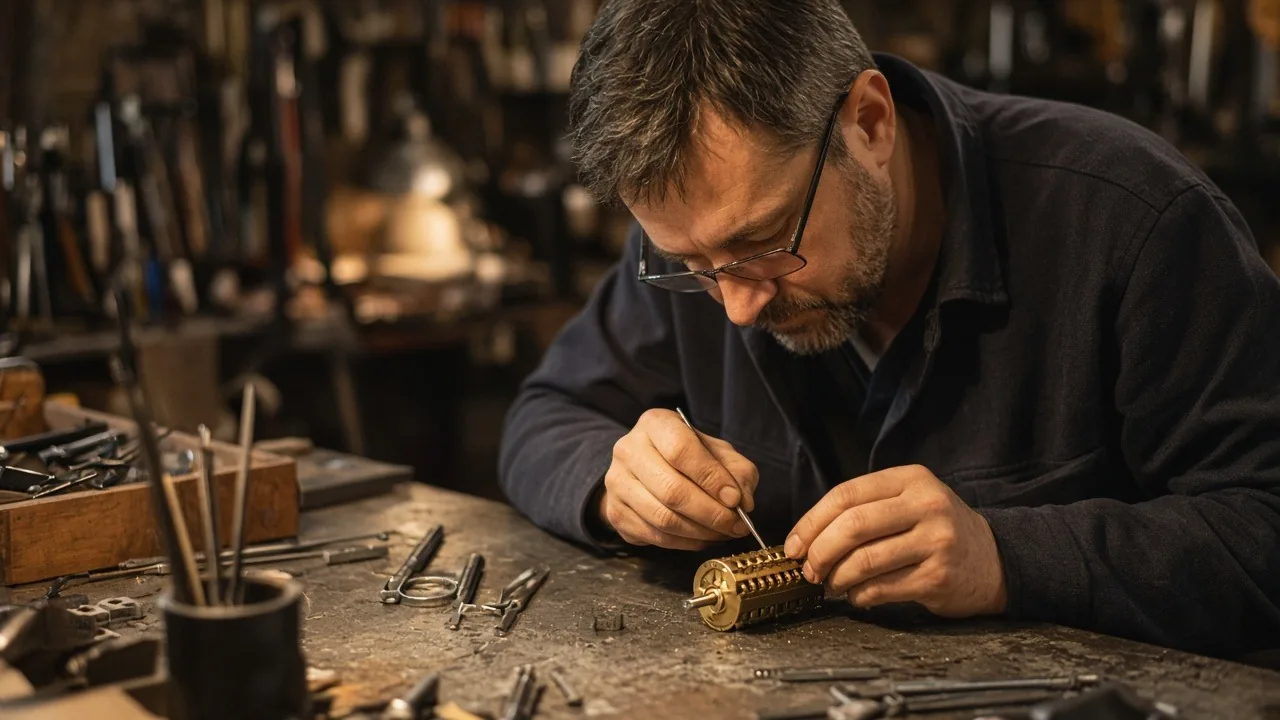
Locksmith business funding pays for the three things a locksmith shop runs on: key-cutting and programming machines, a stocked mobile service van, and working capital for after-hours staffing and slow-paying commercial invoices. The Broker Shop is a broker, not a lender, so one application is matched to the funders whose guidelines you meet.
Equipment financing for key-cutting and programming machines
A locksmith's earning power lives in the machines. Automotive key programming tools, transponder and chip machines, laser and code cutters, and diagnostic gear are expensive, and they keep evolving as vehicles and smart locks change. That is a lot of capital to tie up, but it is also exactly the kind of purchase funding is built for.
With equipment financing, the machine you are buying serves as the collateral, so the funder is secured against the cutter or programmer itself, which tends to make approval more accessible than an unsecured loan. It also lets you preserve cash and stay current on technology, spreading the cost over the working life of the equipment while it earns on every job. For a shop that wants to service more vehicle makes and modern access-control systems, financing the gear is smarter than draining the account.
A mobile van and inventory to stay ready
So much locksmith revenue is mobile, which makes the van its own profit center, and it can be financed as equipment so the vehicle backs the loan. A fully stocked service van with a workbench, key machine, and organized inventory means you finish jobs on the first visit instead of driving back for parts. That readiness is what earns repeat and referral business.
Keeping key blanks, cylinders, smart locks, and hardware in stock also ties up cash, and demand can spike without warning. A business line of credit is the flexible tool for this: you draw what you need to restock or cover a slow stretch, then pay it back down as jobs come in, and the line resets. Because you only carry a balance on what you actually use, it fits the unpredictable flow of service work.
Locksmith financing: equipment vs. working capital
Locksmith financing comes in two broad forms. Equipment financing pays for a specific asset, such as a key programmer, code cutter or service van, and that asset secures the deal. Working capital, such as a line of credit, term loan or revenue-based advance, covers expenses with nothing to repossess, so it is underwritten mainly on your bank deposits.
The practical rule is to match the term to the life of what you are buying. A transponder programmer or a van earns for years, so spreading its cost over a multi-year equipment term keeps the payment in line with the revenue it produces. Key blanks, smart-lock stock, payroll for an after-hours technician or a slow commercial invoice are short-cycle costs, and paying for them with a long loan means you are still paying long after the cash came back. Short-cycle needs belong on a line of credit you draw and repay, or on financing tied to the receivable itself; our comparison of invoice financing vs. invoice factoring explains the two ways to do that.
| Locksmith need | Usually funded with | What secures or sizes it |
|---|---|---|
| Key programmer, code cutter, laser cutter | Equipment financing | The machine itself, sized to the vendor quote |
| Second service van and upfit | Equipment or vehicle financing | The van, sized to the vehicle and upfit quote |
| Key blanks, cylinders, smart-lock inventory | Business line of credit | Your monthly deposits |
| After-hours payroll, slow months | Line of credit or short-term working capital | Deposit history and time in business |
| Commercial rekey or access-control contract | Invoice financing or a term loan | The signed contract or unpaid invoice |
Many shops use both at once: an equipment deal for the van and a modest line of credit for the stock that goes in it. Because The Broker Shop is a broker, one application can be compared across funders that offer each product, rather than forcing one lender’s single product onto every need.
Working capital for 24-7 staffing and commercial contracts
Emergency and after-hours service is a huge part of the value a locksmith offers, but staffing nights and weekends means payroll that has to be met whether the phone rings ten times or twice. And when you expand into commercial work, access control, master-key systems, and building security contracts, you often front labor and hardware before the invoice is paid on net terms.
Working capital smooths both. A business term loan can fund a planned push into commercial contracts, while a line of credit covers the payroll and materials gap on larger jobs. If a big commercial client pays slowly, invoice financing lets you turn that unpaid receivable into cash now rather than waiting on their accounts-payable cycle, so you can keep the schedule and the crew moving.
Locksmith business funding: what funders look at
Locksmith business funding is decided mostly on your bank deposits, not your trade. Funders typically review three to six months of business bank statements, your time in business, how steady monthly deposits are, and any existing advances or loans. Equipment financing adds the value of the van or machine; unsecured working capital leans almost entirely on cash flow.
The shape of a locksmith's revenue matters inside those statements. A mobile, emergency-driven shop shows many small card and cash deposits that spike with lockouts on cold nights and holiday weekends, while a storefront with commercial access-control work shows fewer, larger payments that arrive on net terms. Neither is better in a funder's eyes, but each is read differently: steady daily deposits support a revenue-based product, while signed commercial contracts and a clean receivables list support a term loan or invoice financing. Expect a funder to ask about the split between residential lockouts, automotive keys and commercial work, and to look closely at any month where deposits dropped sharply.
It is a small, specialized trade, which is one reason a generalist bank can be hard to convince. The benchmarks in the next section show how small most shops are, and owner-operators sit outside the official payroll counts entirely, so funders lean on your own deposit history instead of industry averages.
Locksmith industry statistics and financial benchmarks
Locksmithing is a small-business trade almost by definition. The Census Bureau’s 2022 Statistics of U.S. Businesses counted 3,894 locksmith employer firms (NAICS 561622) with 16,320 employees and about $2.6 billion in combined receipts, and 74% of those firms had fewer than five employees. Owner-operators with no payroll are not even in that count.
The same tables give a rough revenue benchmark by size. Locksmith firms with fewer than five employees averaged about $293,000 in annual receipts, while firms with five to nine employees averaged about $920,000. Across all locksmith employer firms, annual payroll came to roughly 30% of receipts, rising from about 25% at the smallest firms to about 32% in the five-to-nine band, a reminder that labor becomes the biggest controllable cost once you add technicians. On the wage side, the U.S. Bureau of Labor Statistics put employment of locksmiths and safe repairers at 15,040 in May 2025, with a mean annual wage of $55,470 and a median of $51,320.
| Locksmith employer firms by size (2022) | Firms | Share of firms | Avg. annual receipts per firm |
|---|---|---|---|
| Fewer than 5 employees | 2,867 | 74% | ~$293,000 |
| 5 to 9 employees | 693 | 18% | ~$920,000 |
| Fewer than 20 employees (all) | 3,793 | 97% | ~$509,000 |
| All locksmith employer firms | 3,894 | 100% | ~$667,000 |
Read these as context, not as targets. They are averages across very different shops, the per-firm figures are computed from the Census totals, and they are receipts, not profit: the Census data reports what came in and what went to payroll, not what was left after parts, vehicles, insurance and rent. To judge whether your own margins are healthy for the trade, compare your profit and loss against your own history and ask an accountant or tax professional to benchmark it. For a funding decision, the number that matters most is your own average monthly deposit, because that is what an offer is sized from.
Funding a second van or a commercial rekey contract
A second service van is usually funded with equipment financing, where the vehicle itself secures the deal, while a large commercial rekey or master-key contract is usually funded with working capital or invoice financing that covers hardware and labor until the client pays. Matching the product to the purchase keeps payments in line with the revenue it creates.
Before adding a van, check whether your call volume can keep a second technician busy: lost calls during peak hours, a waitlist for automotive programming, or regular overflow to competitors are the signs that a second unit will pay its own way. Budget for the upfit (shelving, key machine, inverter, stock of blanks and cylinders), not just the vehicle. For a commercial job such as rekeying an apartment complex or installing access control across an office building, the risk is timing: you buy cores, cylinders and hardware up front and may wait 30 to 60 days for payment. A line of credit covers that gap and resets as the client pays, and if the invoice is large, invoice factoring can turn it into cash before the due date. Because The Broker Shop is a broker, one application can be compared across funders offering each of these, so you are not forced into whichever single product one bank happens to sell.
Locksmith business funding: how much and how fast?
Locksmith business funding through The Broker Shop ranges from $5,000 to $2 million depending on the funder and your deposits, and some working-capital offers fund in as little as 24 hours once approved. Equipment financing and larger term loans usually take longer because the van or machine has to be documented.
How much you can get is driven by the same things funders weigh for any trade: months in business, steady monthly deposits, and what you already owe. A mobile shop with a few years of consistent card and cash deposits is read very differently from a business that opened last quarter, so the honest answer is that the range is wide and the offer comes from the funder, not from us. Speed depends on the product. A short-term working-capital line can move quickly when your bank statements are clean, while financing a second van or a commercial access-control rollout involves a vehicle quote or signed contract. Nothing is guaranteed until a funder makes an offer, and because The Broker Shop is a broker, one 2-minute application lets you compare what several funders would offer before you commit.
How the broker match works
Here is the part that saves you the headache. Instead of applying to funder after funder and racking up rejections, you fill out one 2-minute application and The Broker Shop matches you to the funders whose guidelines you meet. You compare the strongest offers side by side and pick what fits, whether that is equipment financing, a line of credit, a term loan, or a combination.
It is free to you as the applicant, and checking your options will not affect your credit score. As a broker, The Broker Shop does not lend the money itself; it does the legwork of finding the right funders so you can get back to cutting keys and answering calls instead of chasing paperwork. Funding ranges from $5,000 to $2 million depending on the funder and your business.
See what you qualify for
One 2-minute application is matched to the funders whose guidelines you meet. It's free, and checking your options won't affect your credit score.
See What I Qualify For →The bottom line: Locksmithing runs on specialized machines, a stocked mobile van, and around-the-clock staffing, so match equipment financing, a line of credit, and a term loan to the funders whose guidelines you meet, all from one 2-minute application.
Frequently asked questions
Sources: U.S. Census Bureau — 2022 SUSB Annual Data Tables by Establishment Industry (NAICS 561622 Locksmiths: 3,894 employer firms, 16,320 employees, $2.6 billion receipts; size-band firm counts, receipts and payroll) · U.S. Bureau of Labor Statistics — Occupational Employment and Wage Statistics, May 2025: 49-9094 Locksmiths and Safe Repairers (employment of 15,040; mean annual wage $55,470; median $51,320)
Want exact figures for your situation? Try our free loan calculator, payback period calculator and hourly to salary calculator to check the math before you decide.