
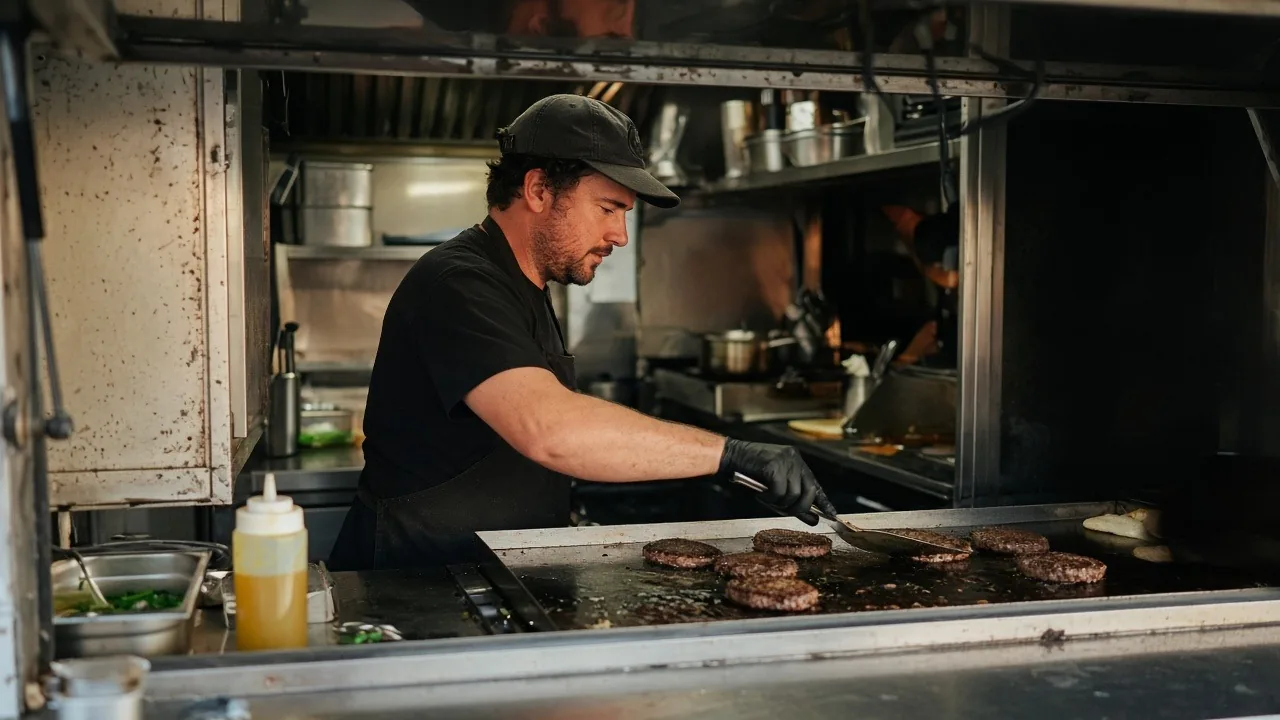
The U.S. food truck industry counted 11,516 employer firms operating 11,611 mobile food establishments in 2022, with 37,137 employees and $3.97 billion in receipts. 80.5 percent of those firms have fewer than five employees, the average firm takes in about $345,000 a year, and the 2.6 percent of operators with 20 or more staff earn 19.3 percent of the money, per Census and BLS data.
How many food trucks are there in the United States?
There are 11,516 employer firms classified as mobile food services (NAICS 722330) in the United States, operating 11,611 establishments, according to the Census Bureau's 2022 Statistics of U.S. Businesses. The category covers food trucks, food carts, trailers and other mobile food stands that prepare and serve food at the vehicle, and the near-match between firms and establishments (11,516 versus 11,611) shows that almost every operator runs a single truck.
Two caveats matter when you compare this with the much larger counts quoted in trade press. First, the Census figure counts only employer firms, meaning businesses with at least one paid employee; an owner who runs the truck alone with no payroll is a nonemployer business and is not in this table, so the true number of trucks on the road is higher. Second, mobile food is a sliver of the restaurant sector: the 11,516 mobile food firms are 2.2 percent of the 516,506 food-service and drinking-place firms in the country and earn 0.44 percent of that sector's $0.9 billion in receipts.
How much revenue does the average food truck make?
Mobile food service firms averaged about $345,000 in annual receipts in 2022 ($3.97 billion across 11,516 firms), or about $342,000 per establishment. The typical truck is smaller than that average: the 9,268 firms with fewer than five employees averaged about $200,000 in receipts, while firms with five to nine employees averaged about $548,000 and those with 10 to 14 employees about $939,000.
The top of the market is a different business. The 297 firms with 20 or more employees, just 2.6 percent of operators, averaged about $2.57 million each and collected $1 million, or 19.3 percent of all mobile food receipts. These are multi-truck fleets, commissary-based caterers and event operators rather than a single truck at a lunch stop. By comparison, the broader special food services group that food trucks belong to (NAICS 7223, which also includes caterers and food-service contractors) counted 27,711 firms and $0.1 billion in receipts, so mobile food is 41.6 percent of that group's firms but only 5.9 percent of its revenue.
How small is the typical food truck business?
80.5 percent of mobile food firms (9,268 of 11,516) have fewer than five employees, and 97.4 percent (11,219) have fewer than 20. Firms under five employees average about 1.1 paid employees each, which in practice means an owner-operator plus one part-time helper. Across the whole industry the average is 3.2 employees per firm.
Employment follows the same pattern as revenue, only less extremely. Firms with fewer than 20 employees provide 26,763 of the industry's 37,137 jobs (72.1 percent), so unlike gyms or salons, where the chains employ most of the workforce, food trucks remain a genuinely small-operator industry on both the revenue and the jobs side. The structure is closer to a trade business than to a restaurant group: one vehicle, one or two cooks, and revenue capped by how many service windows the truck can work in a week.
What do food trucks spend on payroll, and what do cooks earn?
Mobile food service firms paid $1.03 billion in annual payroll in 2022, which is 25.9 percent of receipts. The ratio is lower for the smallest operators: firms with fewer than five employees ran payroll at 19.3 percent of receipts and firms under 20 employees at 22.8 percent, because the owner's own labor is not in the payroll line. Food cost, commissary rent, fuel, permits and the truck itself take the larger shares of a food truck's budget, which is why the vehicle purchase or build-out is usually the financing event in this business.
On the workforce side, the Bureau of Labor Statistics counted 2,705,800 cook jobs in the United States in 2025, with a median pay of $36,640 a year ($17.62 an hour). Employment of cooks is projected to grow 7 percent from 2025 to 2035, adding about 183,200 jobs, which the BLS describes as much faster than the average for all occupations. 76 percent of cooks work in food services and drinking places, the sector that includes mobile food; restaurant cooks are the largest detailed group at 1,417,500 jobs, followed by fast-food cooks at 640,500 and short-order cooks at 138,700.
What these numbers mean for financing a food truck
The data describes a business whose single largest asset is a vehicle and whose revenue is capped by one service window at a time. A new or used truck with a built-out kitchen is normally the first and largest purchase, and because the vehicle and its equipment can serve as collateral, most owners finance it with equipment financing or a work-vehicle loan rather than paying cash. Working capital for a second truck, a commissary lease, event deposits or a slow winter is more often a line of credit or revenue-based funding sized against the truck's monthly card receipts.
Our guide to business funding for food trucks covers the products that fit each stage, and the restaurant industry statistics page puts these figures next to the brick-and-mortar numbers. The Broker Shop is a funding broker, not a lender: one application is matched to the lenders among 50+ whose guidelines fit your business, and those lenders compete for the deal. Checking your options won't affect your credit score, and it is free to apply.
Frequently Asked Questions
How many food trucks are in the U.S.?
The Census Bureau's 2022 Statistics of U.S. Businesses counts 11,516 employer firms operating 11,611 mobile food service establishments (NAICS 722330), the category that covers food trucks, carts and trailers. That figure includes only businesses with at least one paid employee; owner-operated trucks with no payroll are counted separately as nonemployer businesses, so the total number of trucks is higher.
How much does the average food truck make a year?
Mobile food service firms averaged about $345,000 in annual receipts in 2022 ($3.97 billion across 11,516 firms), according to Census SUSB data. Most trucks earn less than that average: firms with fewer than five employees, which are 80.5 percent of the industry, averaged about $200,000, while firms with five to nine employees averaged about $548,000 and the few operators with 20 or more employees averaged about $2.57 million.
Sources: U.S. Census Bureau — 2022 Statistics of U.S. Businesses, firms, establishments, employment, payroll and receipts by NAICS 722330, 7223 and 722, by enterprise size · Bureau of Labor Statistics — Occupational Outlook Handbook, Cooks (2025 employment, median pay, 2025–35 projections, employment by industry)
Found these figures useful? You are welcome to cite or link to this page. Suggested attribution: “Food Truck Industry Statistics 2026,” The Broker Shop — thebrokershopinc.com/food-truck-industry-statistics.html. Every figure links to its original primary source; averages and shares are computed from the Census totals named above.
See what you qualify for
One 2-minute application is matched to the funders whose guidelines you meet. It's free, and checking your options won't affect your credit score.
See What I Qualify For →The bottom line: The food truck industry is 11,516 employer firms and 11,611 trucks and carts earning $3.97 billion, where 80.5 percent of operators have fewer than five employees and the typical truck is a $200,000-a-year business; the vehicle is the asset, the asset is what gets financed, and growth means a second window, not a bigger one.