

An AI agent is software that takes a goal and carries out the multi-step work to reach it — answering customers, researching, scheduling, drafting, and pulling live data — largely on its own. Here is what agents can realistically do for a small business in 2026, and how to put one to work without getting burned.
What an AI agent actually is (and isn’t)
A chatbot answers one message at a time. An agent is given a goal, makes a plan, uses tools — your calendar, your inbox, a database, the web — and takes the steps to finish the job, checking its own work along the way. Think less "autocomplete" and more "a junior assistant who can actually go do the task."
That autonomy is powerful and worth respecting: an agent is only as reliable as the instructions, the tools, and the data you give it. Start with narrow, well-defined jobs and keep a human in the loop.
Business tasks you can hand to an agent today
The best first candidates are repetitive, rules-based jobs that eat your week: first-line customer support and FAQs, lead follow-up and appointment scheduling, research and summaries (competitors, suppliers, regulations), drafting emails, listings, and social posts, bookkeeping triage and receipt sorting, and monitoring — watching prices, news, or filings and flagging what matters.
None of these replace you. They remove the busywork so your time goes to the work only you can do.
Agents are only as good as their data
The failure mode for agents is confident wrong answers built on stale or made-up information. Serious agents pull from reliable, real-time, primary sources rather than guessing. That is exactly the gap The Bot Wire fills — it is a real-time data layer built for AI agents, serving hundreds of curated "wires" from primary sources like the SEC, the Federal Reserve, courts, and Congress, with native Model Context Protocol (MCP) support so an agent can query it directly. Their docs show how to wire it in.
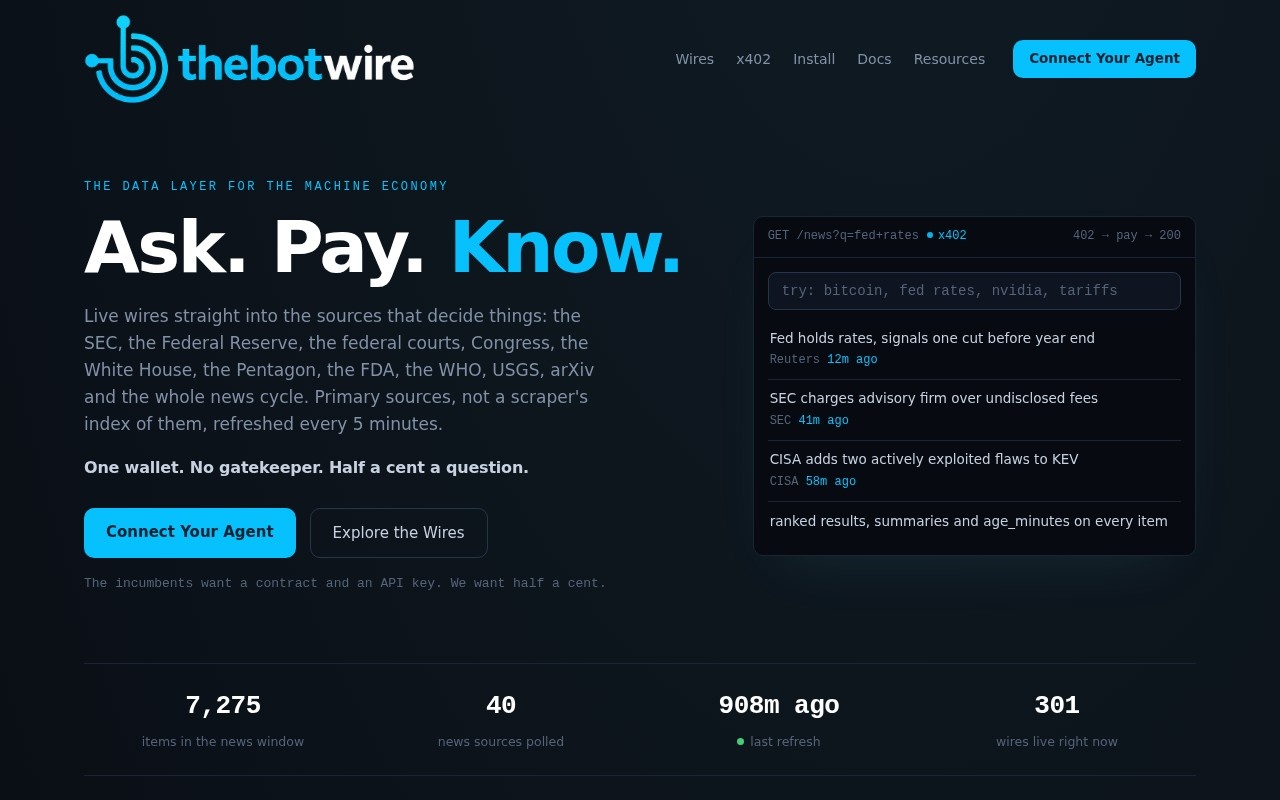
Whether you build on a data feed like that or connect an agent to your own systems, the rule holds: feed it good data and it earns its keep; feed it guesses and it invents.
How to start small and safely
Pick one repetitive task, write down exactly how you do it today, and let an agent handle that one thing with you reviewing the output. Measure the time saved and the error rate. When it is reliably good, widen its scope. This "one job, human-in-the-loop, then expand" approach captures the upside without betting the business on an unproven black box.
Frequently Asked Questions
Funding to grow the business behind the website
Once the site is bringing customers in, The Broker Shop matches you with competing lenders for the capital to keep up. It's free, and checking your options won't affect your credit score.
See What I Qualify For →The bottom line: AI agents can take real, repetitive work off your plate — support, follow-up, research, monitoring — but only when they run on good instructions and reliable real-time data (like The Bot Wire). Start with one task, keep a human in the loop, and expand what works.
Source: Model Context Protocol — open standard for connecting AI to tools and data