
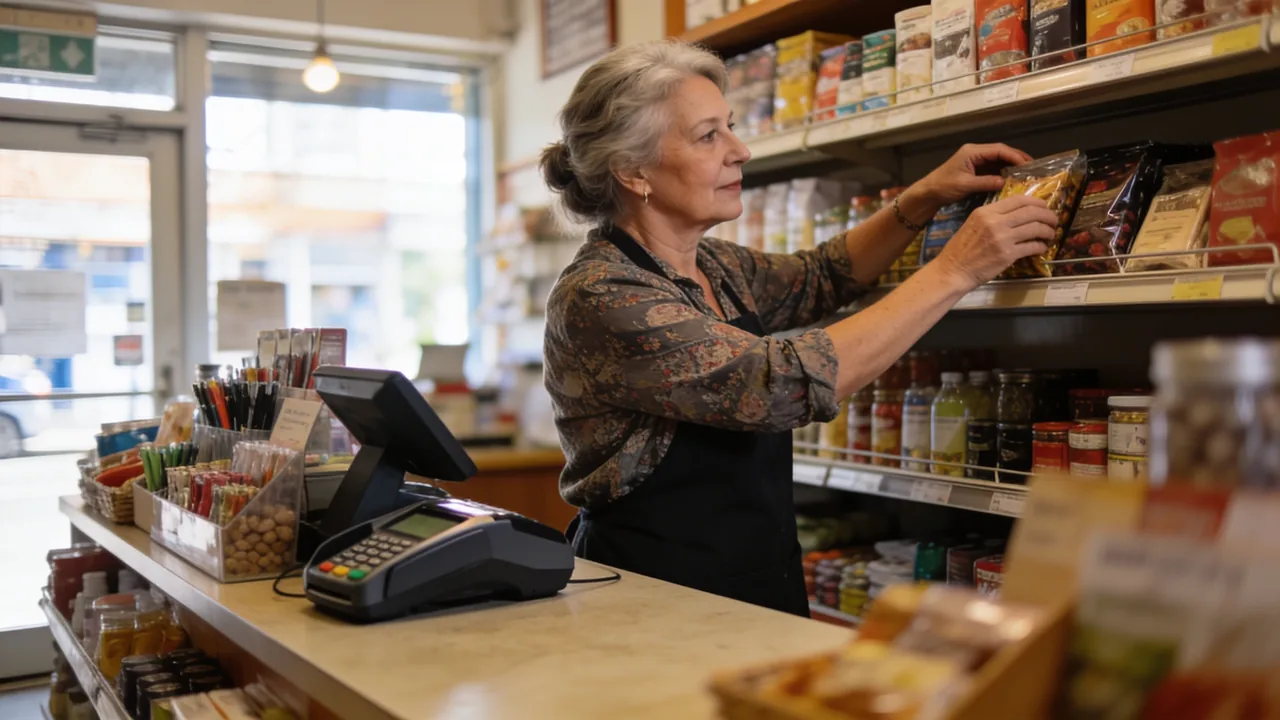
About 4 million small retail establishments operate in the United States, and 98 percent of retailers employ fewer than 50 people, according to the National Retail Federation. NRF forecasts total U.S. retail sales will grow 4.4 percent in 2026 to $5.6 trillion, so the small business share of a very large number is what these statistics are really about.
How many small retail businesses are there in 2026?
Retail reads as an industry of giants and is structured as an industry of small businesses. The National Retail Federation counts roughly 4 million small retail establishments nationwide, with 98 percent of retailers employing fewer than 50 people and 40 percent of all retail jobs sitting at small businesses.
The sector as a whole is the largest private-sector employer in the country, supporting 55 million working Americans — more than one in four U.S. jobs — and contributing $5.3 trillion to annual GDP. Those two facts belong together: retail's economic weight is enormous, and most of the establishments carrying it are owner-run.
How fast is retail growing this year?
NRF forecasts retail sales growth of 4.4 percent in 2026, to about $5.6 trillion, a measure that excludes automobile dealers, gasoline stations, and restaurants. That compares with 3.6 percent average annual growth over the past decade once the atypical 2020 to 2022 period is excluded, so the forecast is for a modestly better than average year.
Census data through the first half backs that up. Advance estimates put June 2026 retail and food services sales at $768.6 billion, up 0.2 percent on the month and 6.7 percent against June 2025. Cumulative sales for January through June 2026 reached $4,420.3 billion, 5.1 percent ahead of the same period in 2025. Growth is real, but part of it is price rather than units.
What the averages hide about a single store
A national growth rate is a poor forecast for one storefront. The Census totals blend big-box chains, grocery, e-commerce, and independents, and the categories move in different directions in the same month. Independent retailers also carry a cost structure the aggregate figures do not show: rent per square foot, card processing on nearly every sale, and inventory bought months before it is sold.
The practical read is to compare yourself to your own prior year and your own category rather than to the headline. If your comparable-store sales are up 2 percent in a year when your category is up 6 percent, you are losing share even though the number is positive. Our guide to inventory management for small business covers the turn and sell-through metrics that make that comparison meaningful.
How independent retailers fund inventory and seasonal swings
Retail's financing need is almost always timing rather than survival. Stock has to be bought, shipped, and shelved before the selling season, which means the largest cash outflow of the year lands in the months with the least revenue. A funding line for inventory that you draw on and repay as goods sell fits that shape far better than a fixed-term note that starts amortizing immediately, and seasonal business funding is built around exactly this mismatch. Retailers selling online as well as in store will find the channel-specific version of this in our guide to ecommerce funding for scaling online brands.
Retailers also have unusually clean underwriting data. Point-of-sale and processor statements show daily volume and seasonality, which lets funders judge an application on revenue patterns instead of collateral. Compare the structures side by side in our overview of small business funding options before committing to one.
The Broker Shop is a funding broker, not a funder — we put more than 50 lenders in competition for one application instead of lending money ourselves. That means you see the structures you actually qualify for side by side and pick the payment schedule that matches how the money comes back in. It is free to apply, and checking your options won't affect your credit score.
Frequently Asked Questions
See what you qualify for
One 2-minute application is matched to the funders whose guidelines you meet. It's free, and checking your options won't affect your credit score.
See What I Qualify For →The bottom line: Retail is a $5.6 trillion sector made up mostly of businesses with fewer than 50 employees, so the number that matters to an independent store in 2026 is not the national growth rate but whether inventory is funded in a way that matches when it actually sells.
Sources: National Retail Federation — NRF Forecasts 4.4% Annual Retail Sales Growth (2026) · National Retail Federation — Small Retail Business Hub · National Retail Federation — Retail's Impact · U.S. Census Bureau — Advance Monthly Retail Trade Survey, June 2026 (CB26-113)
Found these figures useful? You are welcome to cite or link to this page. Suggested attribution: “Retail Small Business Statistics 2026,” The Broker Shop — thebrokershopinc.com/retail-small-business-statistics-2026.html. Every figure links to its original primary source.