
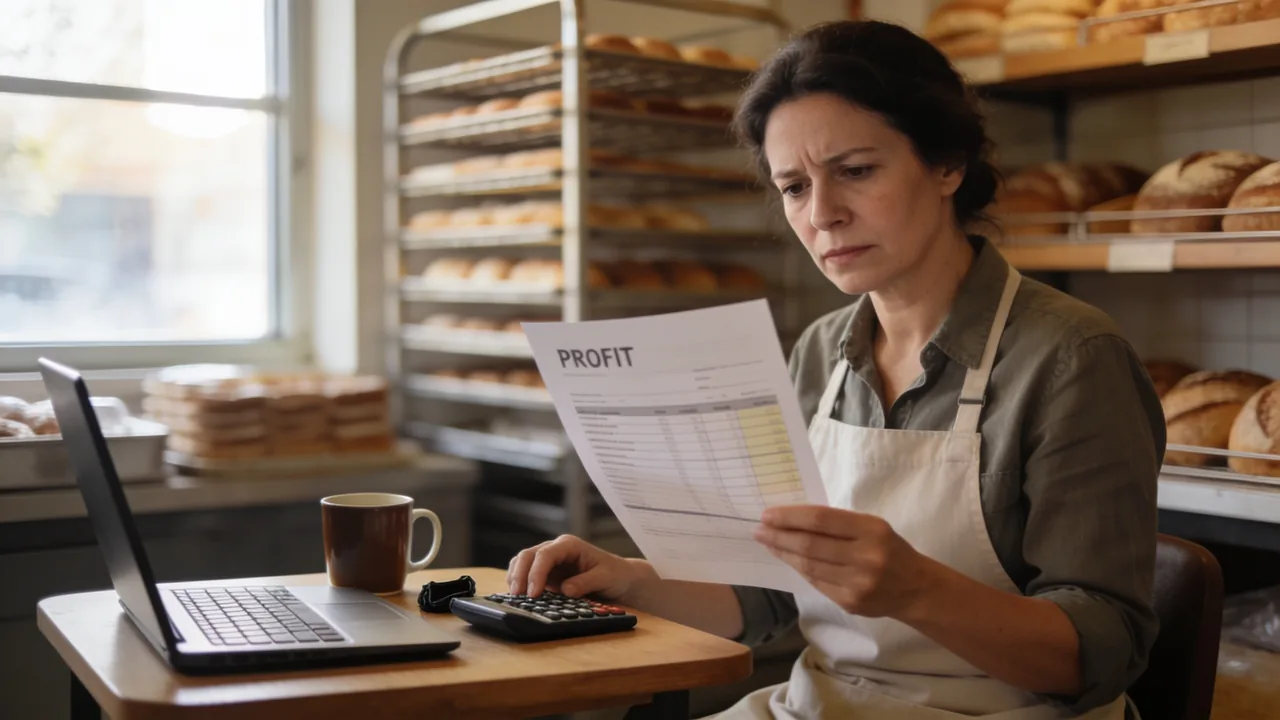
No — not for most business funding. The majority of non-bank products are underwritten on revenue and cash flow rather than on profit, so a business showing a loss on its tax return can still be approved. Profitability matters most where it always has: bank loans, SBA loans and larger amounts.
Do funders actually check whether your business is profitable?
It depends entirely on who you ask. A bank or an SBA lender will look at profitability directly, because it underwrites from filed tax returns and prepared financial statements. A revenue-based funder, a merchant cash advance provider or most online lenders will not ask for a P&L at all on a smaller request — they read three to six months of business bank statements and price the deal off what moves through the account.
That split explains why owners get contradictory answers to the same question. The bank says the business does not qualify; a non-bank funder approves it the same week. Neither is wrong. They are reading different documents, and a business can look weak in one and perfectly serviceable in the other.
It also helps to know that borrowing while under cost pressure is the ordinary case, not the exception. In the Federal Reserve Banks’ 2025 Small Business Credit Survey, 60% of firms applied for financing in the prior 12 months, and the most common reason was to meet operating expenses (56%) — ahead of pursuing an expansion or new opportunity (46%). Funders in this market are not surprised by an unprofitable year; they are set up for it.
Revenue or profit — which one decides your approval?
For most non-bank funding, revenue decides it. What an underwriter is really testing is whether the account can carry the payment on top of everything else already leaving it, and that question is answered by deposits, not by net income. Average monthly deposits, how many deposits arrive in a typical month, average daily balance, negative days and any existing daily or weekly funder debits are the numbers that move a decision.
Profit and revenue also measure different things over different periods. Net income is an accounting result for a completed year, calculated after depreciation, owner compensation, amortisation and one-off write-offs — several of which reduce reported profit without reducing the cash in the account. A business can post a loss on paper and still have deposited steadily every month, which is precisely the case revenue-based underwriting is built to read. Our explainer on the net income formula and the walkthrough on how to read a profit and loss statement cover what those figures do and do not tell you.
If the question behind yours is really “how much do I need to be bringing in,” that is a revenue question rather than a profit one, and the minimum revenue for business funding sets out the thresholds product by product.
When profitability does matter
Profit becomes decisive in three situations: bank and SBA lending, larger requests, and anything underwritten from documents rather than from statements. SBA’s own lending criteria at 13 CFR 120.150 require that loans “be so sound as to reasonably assure repayment,” and list the criteria a lender may consider as credit history, the earnings or cashflow of the applicant, and any equity or collateral. Note the wording: earnings or cashflow. Even in the most document-heavy corner of the market, cash flow is named as an alternative to reported earnings, not merely a supplement to it.
The second trigger is size. Below roughly $150,000, a large part of the market works application-only — statements, an ID and a decision in a day or two. Above that, most funders across every product start asking for returns and financials, and at that point a reported loss stops being invisible. It does not automatically end the conversation, but it becomes something you will be asked to explain rather than something nobody sees.
The third is the shape of the loss itself. A loss driven by a one-off equipment purchase, a bad-debt write-off or a heavy depreciation year reads very differently from a loss driven by revenue that has been falling for three straight quarters. Whether a particular deduction helps or hurts how your return reads depends on your entity type and your full tax picture — ask a tax professional rather than guessing, especially before changing how you file to chase an approval.
How to apply when your business isn't profitable yet
Lead with the account, not the return. If your statements are the strongest part of the file, submit them first and make sure they show what you want read: consistent deposits, few or no negative days, no returned items in the most recent month and no undisclosed funder debits. What funders look for in your bank statements covers the specifics line by line, and how funding underwriting works walks through the decision itself.
Then size the request against cash flow rather than against need. Asking for an amount no realistic reading of your deposits could service is one of the most common reasons a workable file is declined, and it is entirely self-inflicted. A smaller approval you can carry cleanly leaves the door open to a second one later; a decline for over-asking closes it for months.
Finally, explain the loss before you are asked. A short, plain note — what caused it, whether it recurs, what the account has done since — costs nothing and pre-empts the objection. This is where a broker earns its place: The Broker Shop is a brokerage, not a funder, so we read the file first and put it in front of the funders in our network of 50+ whose guidelines actually accommodate a loss year, instead of you discovering the answer one decline at a time. It is free to apply, and checking your options won’t affect your credit score.
See what you qualify for
One 2-minute application is matched to the funders whose guidelines you meet. It's free, and checking your options won't affect your credit score.
See What I Qualify For →The bottom line: Profit is not the gate for most business funding — consistent revenue in the bank account is — so a loss year narrows which funders will look at you rather than ruling you out, and the fix is to apply into the channel that reads statements and to size the request against what your deposits can actually carry.
Frequently Asked Questions
Sources: Federal Reserve Banks — 2026 Report on Employer Firms: Findings from the 2025 Small Business Credit Survey (60% of firms applied for financing; 56% sought it to meet operating expenses, 46% to pursue an expansion) · eCFR — 13 CFR 120.150, SBA lending criteria