
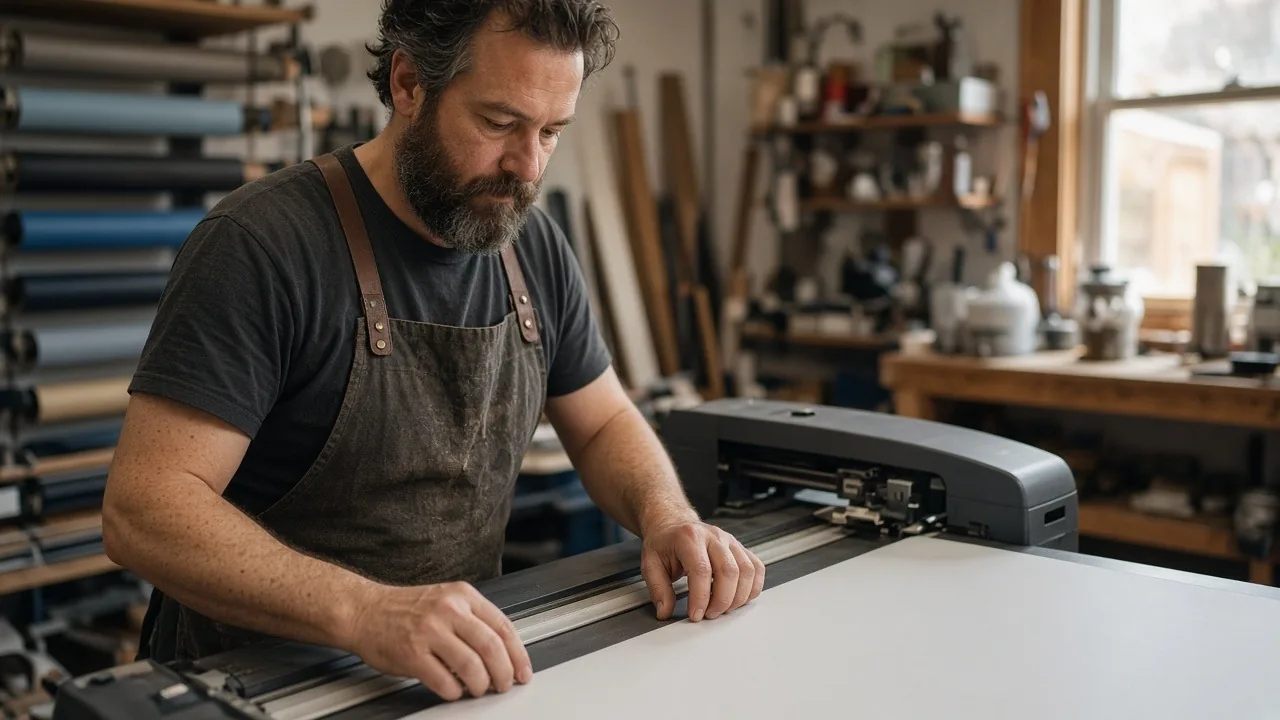
Yes - sign shops can get business funding. Equipment financing fits wide-format printers, CNC routers and channel-letter benders because the machine secures the deal, while a business line of credit covers vinyl, substrates and net-30 install gaps. The Broker Shop is a funding broker, not a funder: one short application matches you to the funders whose guidelines you meet.
Why sign shops need funding that fits their model
A sign business carries cash in two heavy places at once: production gear and standing materials. A wide-format printer, flatbed UV printer, CNC router, laser cutter, vinyl plotter, or channel-letter bender is a major capital purchase, and on top of that you keep vinyl rolls, substrates, aluminum, acrylic, LEDs, and ink on the shelf so you can turn jobs around fast. Both drain working capital before you invoice a dime.
Then there is the install cycle. A storefront sign, a monument sign, or a full vehicle-wrap fleet job often means fronting materials and paying your crew for fabrication and installation weeks before a general contractor, developer, or property manager pays you - and those commercial accounts routinely run net-30 or longer. Expensive equipment, standing inventory, and slow B2B receivables together are exactly why generic bank shopping tends to miss what a sign shop actually needs.
Which funding options fit a sign shop best?
Match the product to the need. The strongest fits for sign shops are:
- Equipment financing - the go-to for buying or upgrading printers, CNC routers, laminators, and benders, because the machine itself typically secures the funding. See equipment financing.
- Business line of credit - a revolving cushion to buy vinyl and substrates in bulk, cover payroll on a large fabrication run, or take a rush job, then repay as installs get paid. See business line of credit.
- Invoice factoring - if net-30 contractor and property-manager accounts are your bottleneck, factoring advances against those unpaid invoices so you are not banking on someone else's accounts payable.
- Business term loan - a lump sum with steady payments for a bigger move like a new production space, a full equipment refresh, or adding a wrap bay. See business term loans.
How does a sign shop qualify for funding?
Funders weigh consistent revenue through your business bank account, time in business, and personal credit more heavily than any single install contract. An established shop with steady deposits - and, for equipment deals, a clear quote on the machine you want - presents a strong picture. Getting your paperwork together speeds the match; see the documents needed for business funding.
Equipment financing is often more attainable for a newer or credit-challenged shop because the printer or router backs the deal, and there are options for thinner credit profiles in our guide to business funding with bad credit. Checking your options with The Broker Shop won't affect your credit score, so there is no downside to seeing where you stand.
Sign-making equipment financing: what you can finance
Sign-making equipment financing covers almost every machine a sign shop runs: wide-format and UV flatbed printers, CNC routers, laser and vinyl cutters, laminators, channel-letter benders and even the bucket truck or install van. The equipment itself usually secures the deal, so the payment is tied to a machine that earns revenue from its first job.
Because the funder can recover the asset, equipment deals tend to hinge on the machine and the vendor quote as much as on your credit file. Funders look at what you are buying (new or used, from which manufacturer, with what expected working life), the invoice amount, and whether your deposits show you can carry one more fixed payment. A clear written quote that lists the printer or router, installation, software and first-year service makes the file faster to price. Soft costs such as RIP software, training and delivery can often be rolled into the same deal, but not every funder allows it, which is one reason to compare several. Bundling a wrap bay heater, a laminator and a new printer into one financed package is common; so is financing a single used CNC router from another shop.
Equipment financing vs. an equipment lease for a sign shop
With equipment financing you own the machine from day one and build equity as you pay; with a lease you rent it for a set term and then return it, renew or buy it out. For sign shops the deciding factor is usually how fast the technology will be out of date, not the monthly payment alone.
Print technology turns over quickly. Ink sets, print speeds and UV-curing capability improve every few years, so a shop that wants the newest wide-format or flatbed printer on a regular refresh cycle often prefers a lease with an upgrade path or a fair-market-value buyout. A CNC router, a channel-letter bender or a laminator, by contrast, can run productively for a decade or more, which favors owning it outright through a loan. Read the end-of-term terms closely: a $1 buyout lease behaves much like a purchase, while a fair-market-value lease keeps payments lower but leaves you negotiating the residual. Our side-by-side guide to equipment financing vs. leasing walks through the numbers, and the same thinking applies to a printing shop's presses and cutters.
Section 179 and sign equipment: the 2026 limits
Section 179 lets a business deduct the cost of qualifying equipment in the year it is placed in service instead of depreciating it over several years. For tax years beginning in 2026, the IRS sets the maximum deduction at $2,560,000, reduced dollar for dollar once qualifying purchases exceed $4,090,000.
Those limits, published in IRS Publication 946, are far above what a typical sign shop spends in a year, so for most shops the cap itself is not the constraint. What matters is timing and eligibility: the machine has to be placed in service during the tax year, and financed equipment can qualify even though you have not finished paying for it, whereas a true operating lease is generally treated differently. Rules on business-use percentage, taxable-income limits and state conformity vary, so ask a tax professional how Section 179 applies to your purchase before you sign. The Broker Shop does not give tax advice; we help you find the financing.
Demand for this kind of growth financing is broad. In the Federal Reserve's 2026 Report on Employer Firms, 60% of small employer firms applied for financing in the prior 12 months, and 46% of those that sought it wanted to pursue an expansion or new opportunity. Only 42% of applicants received the full amount they sought, and approval rates varied by lender type, with 57% of small-bank applicants fully approved. That spread is why comparing funders matters: the same equipment quote can be priced very differently depending on who sees it.
How The Broker Shop matches you to the right funder
The Broker Shop is a broker, not a funder - we do not finance the printer ourselves. We match you to the funders whose guidelines you meet and let them compete for your business, so instead of guessing which bank finances sign-making equipment or advances on net-30 installs, you are put in front of funders who already do. It starts with one 2-minute application.
For an owner juggling design, fabrication, and install schedules, that saves the scarcest resource in the shop: time. You compare the strongest offers in one place rather than applying at bank after bank, and it is free to the applicant. See how a business funding broker works. Advertised funding runs from $5,000 to $2 million depending on the funder and your business.
Sources: IRS Publication 946 — How To Depreciate Property (for tax years beginning in 2026, maximum Section 179 deduction $2,560,000, reduced by the amount by which qualifying property placed in service exceeds $4,090,000); Federal Reserve Banks — 2026 Report on Employer Firms (2025 Small Business Credit Survey) (60% of firms applied for financing in the prior 12 months; 46% sought it to pursue an expansion or new opportunity; 42% of applicants received the full amount; 57% of small-bank applicants fully approved)
See what you qualify for
One 2-minute application is matched to the funders whose guidelines you meet. It's free, and checking your options won't affect your credit score.
See What I Qualify For →The bottom line: Sign shops carry cash in machines, materials, and net-30 installs all at once - the right mix of equipment financing and a line of credit keeps production moving, and one application matches you to the funders whose guidelines you meet.